Ipamorelin research: hormone assays and hospital meals
The research took several directions. The clinical test was far more specific than the reputation that followed.
1998: selective growth hormone release
Novo Nordisk developed Ipamorelin during the 1990s. The founding paper examined a synthetic peptide that could release growth hormone while largely sparing ACTH and cortisol, hormones involved in the stress response. Prolactin changed little too. Tests included rat pituitary cells, anesthetized rats, and conscious swine.
The comparison with the older peptide GHRP-6 matters. Ipamorelin produced potent growth-hormone release with much less stimulation of those other hormones, even at more than 200-fold its GH ED50. The experiments were acute. They established selectivity over the window tested.
I give that achievement its due. “Selective” has a precise meaning here: particular hormone responses were measured and compared. The word becomes far less useful when it is stretched into a general assurance about long-term treatment.

1999: blood measurements in volunteers
The study in healthy male volunteers used single 15-minute intravenous infusions at five dose levels, with 8 men at each level. Larger administered amounts produced proportionally larger ipamorelin concentrations. The terminal half-life was approximately 2 hours, and the growth-hormone response peaked around 40 minutes.
Those measurements answer a pharmacology question well: what entered the blood, how it disappeared, and how hormone release responded. Sleep quality, strength, and recovery from exercise were outside the outcomes measured. The blood-timing discussion stays with those distinctions.
The paper's specificity earns my trust on its narrow question. A route of administration and a measured response make this paper more informative than a treatment description that merely says “fast acting.”
2014: bowel recovery
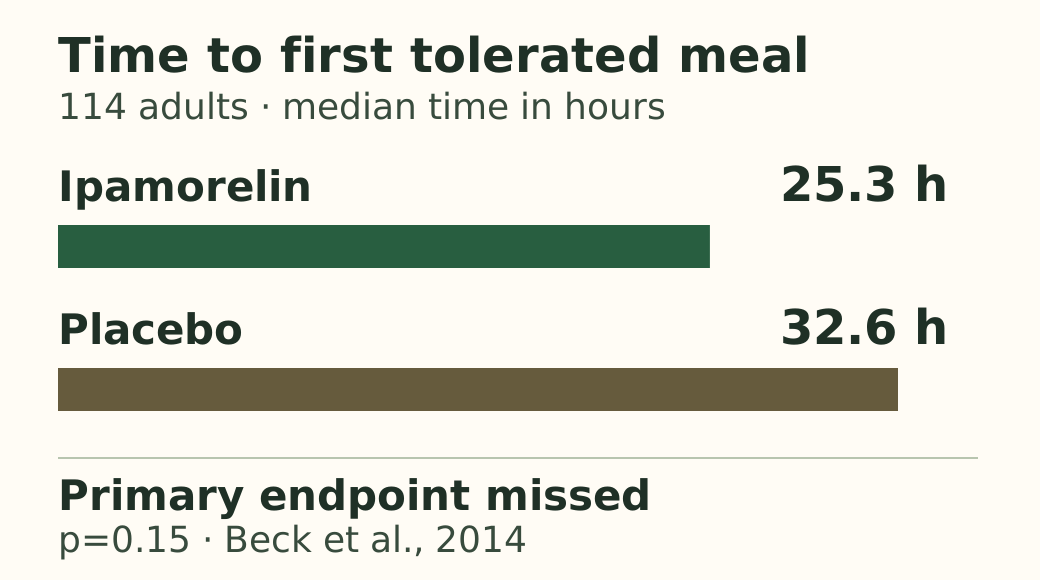
Postoperative ileus is the temporary loss of normal bowel movement after surgery. In the published Phase 2 trial, 114 adults undergoing bowel resection received ipamorelin or placebo through a vein. Staff measured the time to the first tolerated meal.
Median time was 25.3 hours with ipamorelin and 32.6 hours with placebo, with p=0.15. The trial missed its primary endpoint. The medians describe the middle of each group's waiting times; their apparent separation was insufficient to establish a treatment benefit under the study's test.
Treatment-emergent adverse events occurred in 87.5% of the ipamorelin group and 94.8% of the placebo group. These were people recovering from surgery, followed for up to 7 days. The short trial found no ipamorelin-specific safety signal in that setting. It left long-term exposure unanswered.
Neither easy verdict satisfies me. The numerical direction deserves to be reported, and the failed endpoint deserves to remain visible beside it. Declaring a proven recovery benefit would go beyond the result; treating the experiment as though it found absolutely nothing would discard information too.
Bone growth, fat storage, and ferret weight
The animal findings are more interesting when allowed to disagree with a simple wellness story. In the 15-day study in adult female rats, daily longitudinal bone growth was 42 micrometers with vehicle and 44, 50, and 52 micrometers across the ipamorelin amounts tested. Total circulating IGF-1, a protein involved in growth, remained unchanged. The proposed explanation includes local or pulse-driven effects at bone; that interpretation still needs testing.
In mice with deficient or intact growth-hormone function, ipamorelin increased fat storage and leptin over two weeks. That result complicates the assumption that stimulating growth hormone must make an animal leaner.
The 2024 ferret experiment asked another question again. Ferrets receiving cisplatin chemotherapy had approximately 24% less body-weight loss during the last measured day of the delayed phase, 48–72 hours. Ipamorelin did not reduce vomiting. Preserving weight and relieving sickness separated in the same experiment.
For me, the ferret result is a reason to stay curious about the compound's biology. It offers no human evidence of fat loss, and its useful direction was preservation of weight during chemotherapy.
The 2026 reviews
The orthopaedic review calls for rigorous clinical evaluation, while the aging review emphasizes missing long-term safety data. A separate sports-medicine primer describes stronger muscle contractions in mice given CJC-1295 with ipamorelin after glucocorticoid-induced muscle loss.
The publication date alone cannot turn an animal result into a patient result. The missing experiment, for me, connects the popular claims to measured improvements in people. The combination page examines how studies of other hormone-releasing compounds became part of this discussion.